

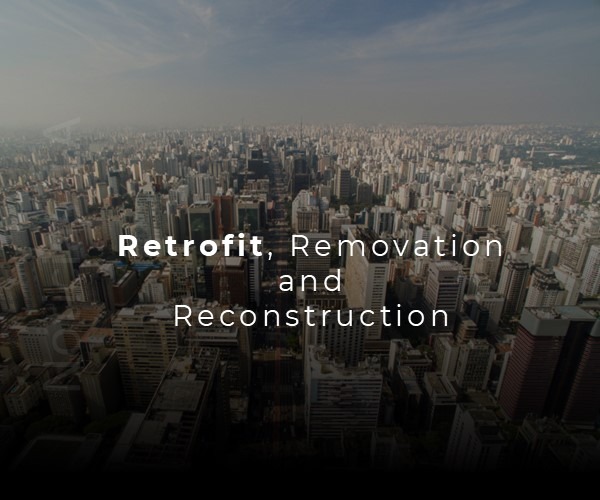
In the constant evolution of urban centers, commercial properties face the challenge of remaining up-to-date and functional in the face of new market and society demands.
In this context, concepts such as Retrofit, Reform and Reconstruction emerge as essential solutions to revitalize, adapt and, when necessary, rebuild commercial spaces.
Each of these processes has distinct characteristics that meet different needs and objectives. And not only that: depending on the situation, it is necessary to use one approach over another.
In this article we will explain what each concept is, show the main differences between them, and give some examples of Retrofit application. Enjoy reading!
What is Retrofit?
Retrofit is a technique designed to update and modernize existing buildings and structures, promoting not only an aesthetic renovation, but also significant improvements in terms of safety, accessibility and sustainability.
Originating in Europe, this concept emerged as an innovative response to the preservation of historic buildings, allowing them to adapt to modern needs without losing their original architectural and cultural characteristics.
The process goes beyond simple renovation, integrating advanced technologies and high-quality materials to improve the performance of buildings in several aspects, such as:
- hydraulics;
- electrical;
- air conditioning systems.
This is done while maintaining the structural and stylistic integrity of the heritage. Unlike traditional renovations, retrofitting focuses on preserving the architecture while implementing solutions that comply with current regulations.
What is Reform?
Renovation is a process that aims to renew, repair or adapt an existing structure or building, without building something completely new.
It differs from a new construction because it works on what has already been built, seeking to improve, modify or expand spaces according to new needs or desires.
Renovations can vary in scale, from small repairs and aesthetic adjustments, such as painting and changing coverings, to more significant interventions that involve structural changes, such as the demolition of walls to create new spaces.
Its main difference compared to Retrofit is that the characteristics of the properties are not always maintained, and the facade and interior can even be completely changed.
However, when it comes to properties that have been listed, renovation is not permitted, and it is necessary to implement the Retrofit process to maintain the initial characteristics of the property considered a historical heritage site.
What is Reconstruction?
Reconstruction, in turn, refers to the process of completely demolishing an existing structure and building a new one in the same location or replacing the previous one.
This process is generally adopted in cases where the existing structure is irreparably damaged or when new construction is more economically and technically viable.
It is worth noting that it does not apply to properties that have been listed and that cannot lose their characteristics. Therefore, the reconstruction process needs to be thoroughly evaluated within that specific context.
What is the central difference between the concepts?
The difference between retrofit, renovation and reconstruction lies in the scale and purpose of the interventions. Retrofit focuses on updating and modernizing while maintaining the original structure and style, often to improve efficiency and sustainability.
Renovation involves changes and improvements to an existing structure, which can be aesthetic or functional, without completely changing the property.
Reconstruction involves the total or partial demolition and reconstruction of a building, generally when it is damaged or to be readapted to new uses.
Examples of Retrofit application in Brazil
In Brazil, several retrofit projects have revitalized spaces and buildings, combining modernity with historical preservation. Notable examples include:
São Paulo State Art Gallery
This project, led by Paulo Mendes da Rocha, aimed to modernize the 19th century building, preserving its original features while improving aspects such as natural lighting and accessibility.
Martinelli Building in Sao Paulo
Considered the city’s first skyscraper, the Martinelli Building’s retrofit focused on adapting the historic building to modern work styles while maintaining its iconic architectural features.
SESC Pompeii
Lina Bo Bardi transformed former warehouses of a drum factory into this renowned leisure and cultural facility, applying critical restoration concepts to preserve historical elements while introducing new features.
Gallery Building in Rio de Janeiro
This building was completely revitalized by Tishman Speyer, incorporating modern technologies in electrical, hydraulic and telecommunications systems, in addition to reinforcing the structure to meet contemporary demands.
Hotel Fasano in Salvador
Originally an art deco building, the retrofit transformed the space into a luxury hotel, preserving the historic aesthetic while modernizing the facilities.
Building Cabo Branco in João Pessoa (PB)
The retrofit transformed the former Porto Bello Apart Hotel into a modern residential building, standing out as one of the first retrofit projects in the Northeast region.
All You Need in Curitiba (PR)
This retrofit project transformed the old Guilherme Weiss building, damaged by fire, into modern, super-compact residential units, with innovations such as smart furniture and electronic locks.
These projects exemplify how retrofitting in Brazil has been used not only to preserve historic buildings, but also to redefine and revitalize urban spaces, combining tradition and innovation in a sustainable way.
Final considerations
As we can see, understanding the distinctions between retrofit, renovation and reconstruction is fundamental for any intervention in commercial properties, especially in large urban centers, where historical preservation and infrastructure modernization are intertwined.
Retrofitting is emerging as a prominent strategy for updating older buildings without compromising their historic features, addressing both contemporary energy efficiency and affordability needs.
On the other hand, renovations and reconstructions allow spaces to be adapted or recreated to meet current and future usage requirements, respecting or redefining the urban memory of the places.
Practical examples of retrofitting in Brazil, such as those cited in this article, illustrate not only the technical and economic viability of these interventions, but also their potential to revitalize and enhance urban areas.
And if you are looking to revitalize a historic property and don’t know how to proceed, contact LA Arquitetura & Engenharia. We will evaluate your property and ensure that the retrofit complies with the legislation in the best possible way!
Hugs and see you later!
Suelem Ribeiro
Recent Comments